Masterpieces That Fumbled the Ending: Evangelion, AoT, and the 'Aliens Did It' Syndrome
When great anime suddenly forget how to end. A deep dive into the most controversial finales that broke the fandom—from Evangelion's existential breakdown to Attack on Titan's 'thank you for genocide'.
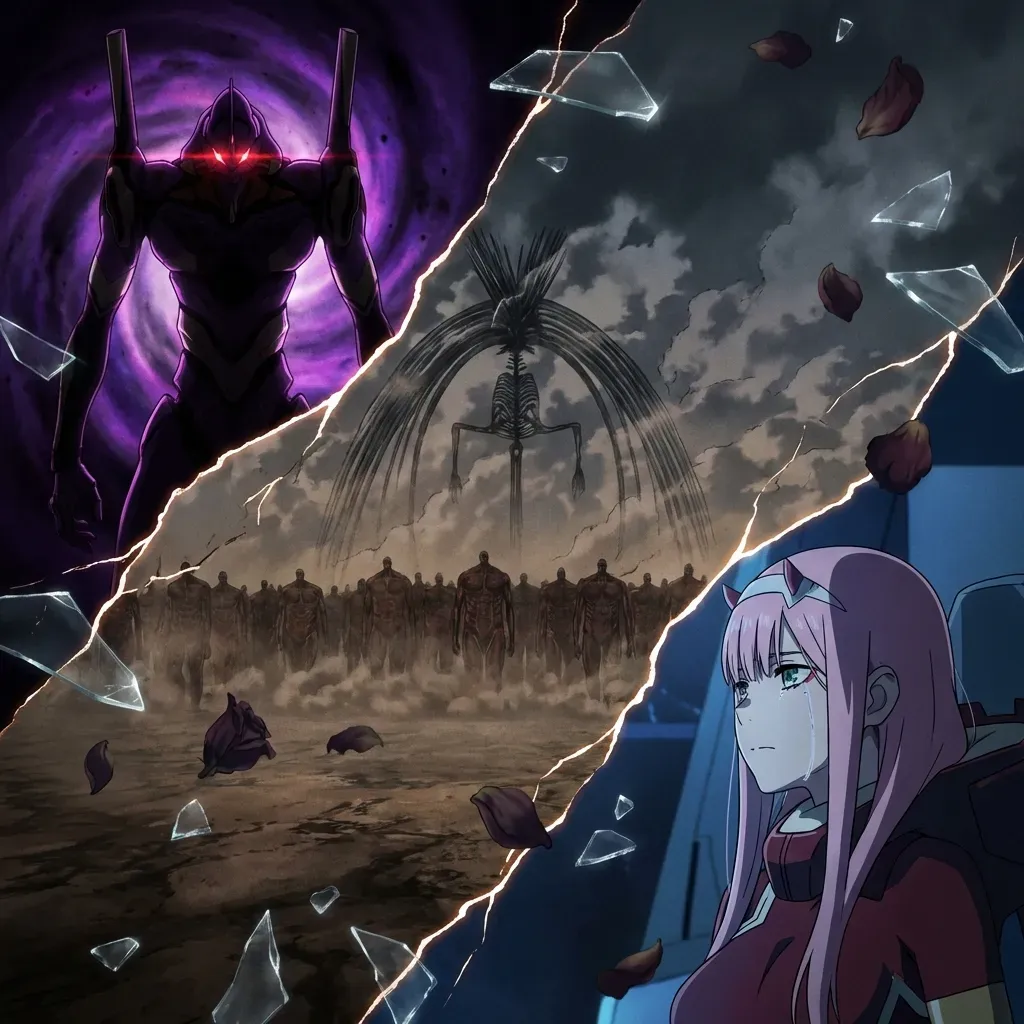
Some anime are masterpieces. Right up until they aren't.
We've all been there: 24 episodes of pure brilliance, character development that makes you cry, world-building that makes you theorize at 3 AM—and then the finale drops like a wet napkin on a five-star meal. Suddenly, the fandom splits in half. Half says "It's DEEP, you just didn't get it!" The other half says "The writer ran out of ideas."
Let's talk about the anime that had everything—until they had to finish the story.
| Anime | The Good | The Controversial Ending |
|---|---|---|
| Neon Genesis Evangelion | Revolutionary mecha, deep psychology | Existential slideshow vs. apocalyptic movie |
| Attack on Titan | Best world-building in shonen | "Thank you for becoming a mass murderer" |
| Darling in the Franxx | Zero Two carried the entire show | Surprise aliens in the final episodes 💀 |
Score: 8.0/10 (Controversy Rating)
Pros: These endings spark discussion for decades.
Cons: They also spark rage. Lots of rage.
Evangelion: "Congratulations!" vs. "What the Hell Did I Just Watch?"
Let's start with the godfather of controversial endings.
Neon Genesis Evangelion is a masterpiece. It redefined the mecha genre, gave us one of the most psychologically complex protagonists in anime history, and made depression look aesthetic before it was cool. Then it ended with two episodes of Shinji having a therapy session inside his own head while everyone claps and says "Congratulations."
Budget ran out? Artistic vision? Anno having a breakdown? All of the above? Nobody really knows.
Then came The End of Evangelion—a movie that basically said "You wanted closure? Here's Asuka getting dismembered, Shinji having a mental breakdown, and humanity liquifying into orange juice." It's beautiful, horrifying, and leaves you with more questions than answers.
The fandom has been divided for decades. Some say the TV ending is the "true" ending—a symbolic representation of Shinji finally accepting himself. Others say EoE is the real deal and the TV ending was just copium. Both camps will argue until the heat death of the universe.
Attack on Titan: "Thank You, Eren"
Oh boy. Here we go.
Attack on Titan had arguably the best first season in anime history. The mystery of the walls, the titans, the basement—it was perfect setup. For years, we theorized. We argued. We waited for the payoff.
And then... we got that chapter.
Eren, who spent the entire series fighting for freedom and protecting his friends, commits genocide on 80% of humanity. His motivation? He didn't fully know, but he "just had to do it." Reiner thanks him. Mikasa thanks him. The entire cast thanks him for becoming a mass murderer for their sake.
The "Thank you for becoming a mass murderer for our sake" meme was born. The fandom exploded. Some defended it as a tragic, realistic ending about the cycle of violence. Others called it character assassination. The AOE (Anime Original Ending) cult rose hoping MAPPA would "fix" it.
MAPPA didn't fix it. The anime ending was the same. The rage continues.
Darling in the Franxx: "Wait, There Are Aliens Now?"
I genuinely believe some executive walked into the studio at episode 20 and said "This show needs aliens. Add aliens."
Darling in the Franxx was a solid mecha romance for about 15 episodes. Zero Two and Hiro's relationship was compelling. The world-building about APE and the adults was intriguing. It felt like a show going somewhere interesting.
Then, with about 5 episodes left, the show revealed that the true villains were... aliens. Random aliens from space. The entire conspiracy? Aliens. The adults? Puppets of aliens. The solution? Hiro and Zero Two fly into space, fight the aliens, and die.
It felt like watching two different shows stitched together by someone who ran out of time. The romance ended in tragedy. The world-building was thrown out the window. The fans were left asking "Was any of this planned?"
The answer, based on interviews, seems to be "no."
Why Do Great Stories Fail at the End?
Three reasons:
1. The Setup Is Easier Than the Payoff
It's easy to create mysteries. It's hard to answer them satisfactorily. Every twist you set up needs resolution, and the more complex your story, the more impossible it becomes to tie everything together. Attack on Titan had so many plot threads that no ending could satisfy everyone.
2. Author Burnout
Writing a long-running series is exhausting. By the time you reach the ending, you've been living with these characters for years—sometimes decades. Anno was clinically depressed during Evangelion. Isayama was reportedly exhausted by the end of AoT. Creativity suffers when the creator is running on fumes.
3. Executive Interference
Sometimes, the ending isn't the author's choice. Studios want more episodes. Networks want specific themes. Companies want merchandise opportunities. Darling in the Franxx reeks of "studio notes" overriding the original vision.
The Uncomfortable Truth
Not every story deserves a perfect ending. Sometimes, the journey is the point.
Evangelion's messy ending doesn't erase the brilliance of the first 24 episodes. Attack on Titan's controversial finale doesn't undo the years of incredible storytelling. Darling in the Franxx's alien nonsense doesn't make Zero Two any less iconic.
We want closure. We want satisfaction. We want everything to make sense. But sometimes, stories are like life—they just end, and we're left picking up the pieces.
Does that excuse bad writing? No. Should we critique endings that don't work? Absolutely. But maybe we can also appreciate that making a story end well is one of the hardest things in fiction.
These anime are masterpieces despite their endings, not because of them. And honestly? The controversy is part of what makes them legendary.
Would anyone still be talking about Evangelion if the ending was "normal"? Probably not.
You might also like
Sha Naqba Imuru: Gilgamesh's Most Broken Ability Explained
Why is Gilgamesh actually unbeatable? Sha Naqba Imuru is the reason. Where to watch Fate/stay night? Crunchyroll and Netflix.
![The Ultimate Fate/strange Fake Guide: Canon, Timeline, Watch Order & Everything Explained [2026]](https://cdn.visualotaku.com/images/fate-strange-fake-ultimate-guide-hero.webp)
The Ultimate Fate/strange Fake Guide: Canon, Timeline, Watch Order & Everything Explained [2026]
Is Fate/strange Fake canon? Where does it fit in the timeline? Watch order? All your questions answered in one place. Streaming on Crunchyroll.
No Saber Class? The 5 Broken Rules of Fate/strange Fake's False War
Why the Snowfield Holy Grail War has no Saber class, 13 Servants, and runs on a 'modded' Grail system. Full mechanics breakdown.